By Syed Muhammad Daud Rizvi — Co-founder of TapOkie. Built the app after recognising how many people live alone with no simple way to let someone know they are OK each day.
Medical alert pendants give 24/7 emergency response via a monitoring centre — ideal for high fall-risk individuals. Daily check-in apps like TapOkie send an automated SMS to your contacts if you miss your morning tap — ideal for independent adults who want a lightweight daily signal without hardware or a call centre.
If you live alone — or you have a parent who does — you have probably come across two very different products pitched as solutions to the same worry: what if something happens and nobody knows?
On one side: the medical alert pendant, a wearable button connected to a 24/7 monitoring centre. On the other: a daily check-in app, a habit-based routine where a missed tap triggers an SMS to the people you trust.
Both products exist because delayed discovery is a real and serious problem for people living alone. But they solve it in fundamentally different ways, for different people, at different price points. Picking the right one — or knowing when to use both — matters.
This guide compares the two honestly. No scare tactics, no bashing either category.
What a Medical Alert Pendant Actually Does
A Personal Emergency Response System (PERS) — the category that includes Life Alert, Lifeline, and many others — works like this: you wear a button (on a lanyard, wristband, or sometimes a smartwatch). You press it in an emergency. A signal goes to an Automatic Response Centre (ARC), where a trained operator answers within seconds, speaks to you through a base unit or the device itself, assesses the situation, and dispatches emergency services if needed.
That is a powerful chain of events. For someone with a high fall risk, a cardiac condition, or early-stage mobility issues, that call-centre dispatch can be the difference between a recoverable incident and a tragedy.
Where PERS systems genuinely shine:
- You need someone to respond, not just to be notified — especially if you cannot speak or move after an incident
- You want 24/7 coverage including nights and weekends, without burdening family members
- Fall detection is important (some units detect a fall automatically without a button press)
- You are comfortable wearing hardware consistently every day
Honest trade-offs to consider:
- Monthly monitoring fees typically range from £20–£50/month (or $30–$60 USD), plus equipment costs — some on long-term contracts
- Many people, particularly younger seniors or those who think of themselves as active and independent, resist wearing a pendant daily — the stigma is real and well-documented
- False alarms are common and can be embarrassing or create unnecessary strain with the monitoring centre
- PERS responds to a crisis that is happening right now — it does not tell your family whether you are generally okay day-to-day
What a Daily Check-In App Actually Does
A daily check-in app works on a completely different principle. There is no hardware, no monitoring centre, and no emergency dispatch. Instead, you build a small daily habit: once a day (or however often you choose), you open the app and tap a button to say you are okay.
If you miss that check-in by a defined window, the app automatically sends an SMS to your verified contacts — a family member, a friend, a neighbour — so they know to check on you.
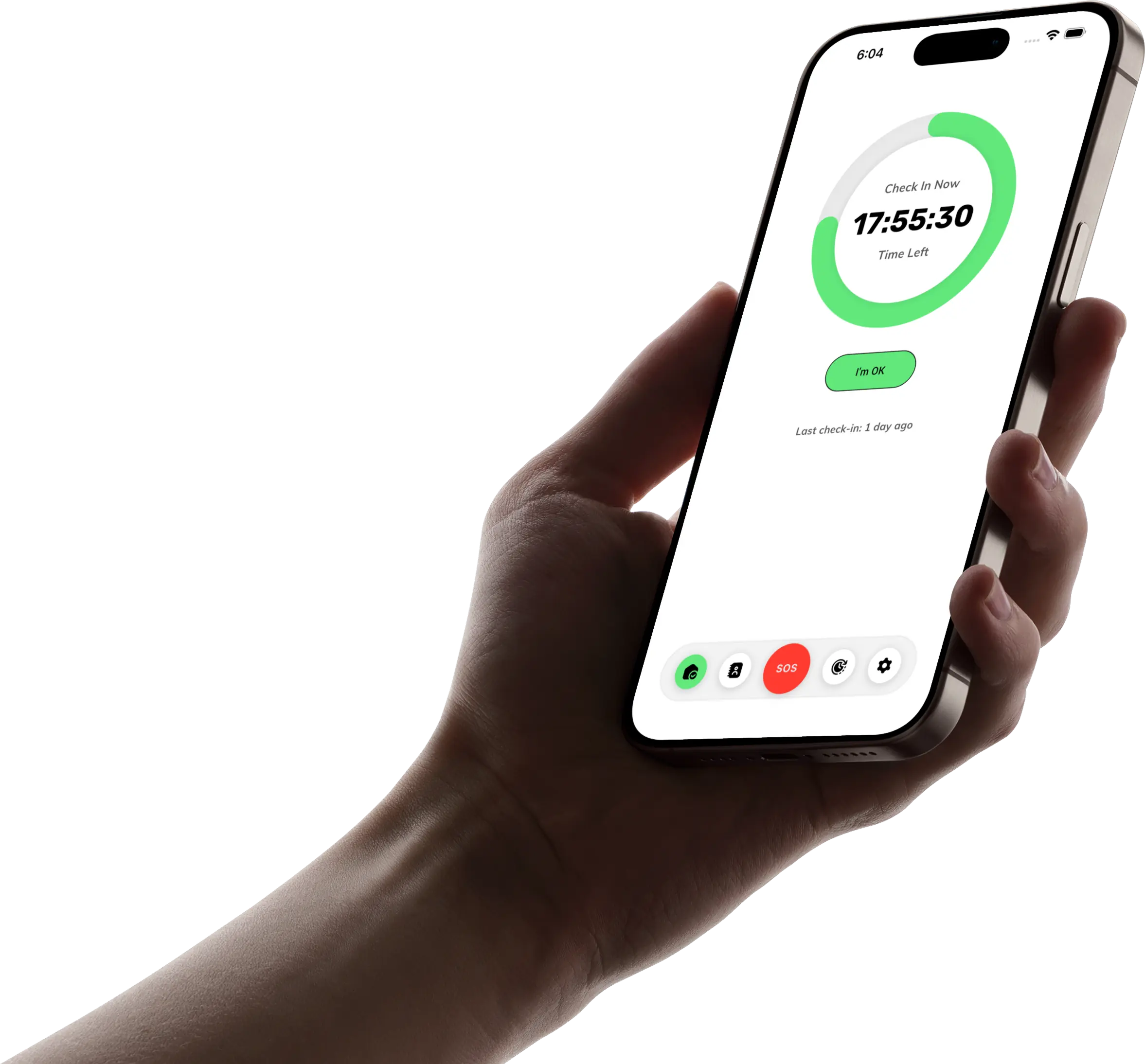
TapOkie works exactly this way. One tap each morning says I'm OK. If the tap does not arrive, your verified contacts receive an SMS alert. Those contacts do not need the app themselves — they just get a text. No call centre is involved.
Premium users also have access to a one-tap emergency button that sends an immediate SMS directly to their verified contacts — useful when you want to reach your people fast, rather than an operator you have never met.
Where a daily check-in app genuinely shines:
- You are independent and active, but living alone — the worry is not an imminent fall, it is delayed discovery if something happens overnight or during a quiet patch
- You want your family to have peace of mind without feeling tracked or monitored constantly
- You (or your family) cannot justify or do not want a monthly monitoring contract
- You already have your phone nearby most of the time — making the check-in tap part of your morning routine is low friction
- You want a dignity-preserving option — no wearable hardware, no stigma of a medical device
Honest trade-offs to consider:
- A check-in app does not respond to an emergency — it alerts people who then decide what to do. If you cannot reach your phone, the check-in will not happen until the window expires
- The response time depends on how quickly a human contact acts on the SMS — this is not ARC-speed dispatch
- It relies on building and sticking to a daily habit; some people find this easier than wearing hardware, others do not
- Not suitable as a replacement for PERS in high-acuity situations (serious fall risk, cardiac history, living in a remote area with slow emergency response times)
Comparing the Two Side by Side
| Medical Alert Pendant (PERS) | Daily Check-In App (e.g. TapOkie) | |
|---|---|---|
| Emergency response | ARC operator dispatches services | SMS to personal contacts |
| Hardware required | Yes — button/wearable | No — phone only |
| Monitoring fee | Often £20–£50+/month (or $30–$60 USD) | Free tier; Premium ~$4.99/month |
| Fall detection | Available on some devices | No |
| Daily wellness signal | No | Yes — missed tap alerts contacts |
| Contact needs an app | No | No |
| Stigma concern | High for many users | Low |
| Best for | High fall/medical risk | Independent adults, light daily signal |
When to Use Each — and When to Use Both
Choose a medical alert pendant if: you or your family member has a documented fall risk, a serious cardiac or neurological condition, or has already experienced a significant health event. The monitoring centre backup is genuinely valuable when the person may not be able to operate a phone at all.
Choose a daily check-in app if: you are independent, not considered high-risk, and the primary concern is that nobody would know quickly if something happened — delayed discovery overnight, after a long weekend, or during a quiet stretch where normal contact might not happen. A check-in app is also a strong option for people who flat-out refuse to wear a pendant.
Consider using both if: someone has a moderate risk profile — perhaps they are older, live alone, have some mobility concerns but remain functionally independent. The PERS handles the acute emergency scenario; the daily check-in provides a baseline wellness signal and means family are not entirely reliant on the monitoring centre for peace of mind. The costs can overlap, but the jobs these tools do are different enough that some families find both worthwhile.
Common Questions
Is a daily check-in app the same as a medical alert system?
No — and it is important to be clear about this. A medical alert system employs a trained operator who can dispatch emergency services. A daily check-in app sends a notification to people you already know. Both are useful; neither replaces the other for high-acuity situations.
What happens if I forget to check in but I'm fine?
Your contacts receive an SMS and will likely try to call or message you directly. You can let them know you are okay and the alert was a false alarm. It is mildly inconvenient, but most families find it far preferable to the alternative.
Does TapOkie use GPS or track my location?
No continuous GPS. Location in alerts is optional and uses normal device permissions — not an always-on map of where someone goes. There is a separate post on this: Check-in, not tracking — what the difference means for your privacy.
My parent refuses to wear a pendant. Is a check-in app a reasonable alternative?
For people with low-to-moderate risk profiles who are otherwise independent, yes — a daily check-in app is often more sustainable precisely because it removes the stigma of wearing medical hardware. That said, if there is a genuine high-risk medical profile involved, it is worth a conversation with a GP or occupational therapist before ruling out a PERS entirely.
Can my contacts use TapOkie too?
Your verified contacts just receive SMS alerts — no app, no account, no setup required on their end. If they want their own check-in routine, they can download TapOkie separately and set up their own contacts independently.
A Note on TapOkie
TapOkie is a daily check-in app built for independent adults who live alone and want a quiet, low-friction way to let the people they trust know they are okay. One tap each day. If the tap does not come, an SMS goes out automatically.
It is not a medical alert system. It does not dispatch anyone. What it does do — reliably and simply — is close the gap between "everything is fine" and "nobody has heard from them in three days."
If that gap is what worries you, download TapOkie and set up your first check-in today.
Related reading: Panic Button vs Daily Check-In for Independent Adults · Apple Watch Fall Detection vs a Check-In App · Living Alone and Falls: 5 Tools That Help · Check-In, Not Tracking · How to Check on Elderly Parents Remotely · Alexa Care Hub vs Daily Check-In App