By Syed Muhammad Daud Rizvi — Co-founder of TapOkie. Built the app after recognising how many people live alone with no simple way to let someone know they are OK each day.
When meeting someone new, a daily check-in gives a trusted person a safety net without sharing your live location. If you miss your check-in window, they get an alert with context. TapOkie's optional Safety Trail lets you quietly log places and photos that are only shared if you do not check in.
Most advice about meeting strangers covers the obvious ground: meet in public, tell a friend, trust your instincts. All of that is sound. But there is a practical gap in the middle that does not get much attention — how, exactly, do you "tell a friend" in a way that is actually useful, without turning an ordinary evening into a surveillance exercise?
Sharing your live location for an afternoon means your friend can see every street you walk down and every place you stop. That is more information than most situations need, and for many people it feels intrusive in both directions — you feel watched, and your friend feels the low-level pressure of a live map they did not ask to be responsible for.
There is a simpler approach: a daily check-in as a quiet safety net, with the option to log a bit of context if a particular situation feels like it warrants it.
The situations that make you pause
Some plans feel entirely straightforward. Catching up with someone you have known for years, meeting a colleague for a coffee — no particular thought required.
Others carry a small background uncertainty. A first date with someone you met online. Buying something listed on Facebook Marketplace or a local selling group. A new social situation where you do not know everyone in the room. Collecting something from a private address. Visiting someone's home for the first time.
These are all ordinary parts of life, and most of them go exactly as expected. But the fact that you are reading this suggests you know the feeling — the small, sensible voice that says it would be good if someone knew where I was going.
That feeling is worth listening to. And it is worth having a practical, low-friction answer ready.
The problem with live location sharing
Apps built around continuous location sharing are designed for ongoing use: families coordinating, teenagers and parents, partners who want to see each other's commute. That is a reasonable tool in some contexts.
For a one-off occasion, it creates a different dynamic. Someone else has access to your location for the whole day, not just the relevant window. And if you value your independence — which most people do — that can feel like a larger trade-off than the situation requires.
There is also a subtler issue: live location sharing can create anxiety in the person watching. If you are a few minutes late and not where they expected, they can see exactly where you are and start to worry. That dynamic can be more stressful for both of you than reassuring.
The alternative is a system that is quiet when everything is fine and useful when something is not.
How a daily check-in works as a safety net
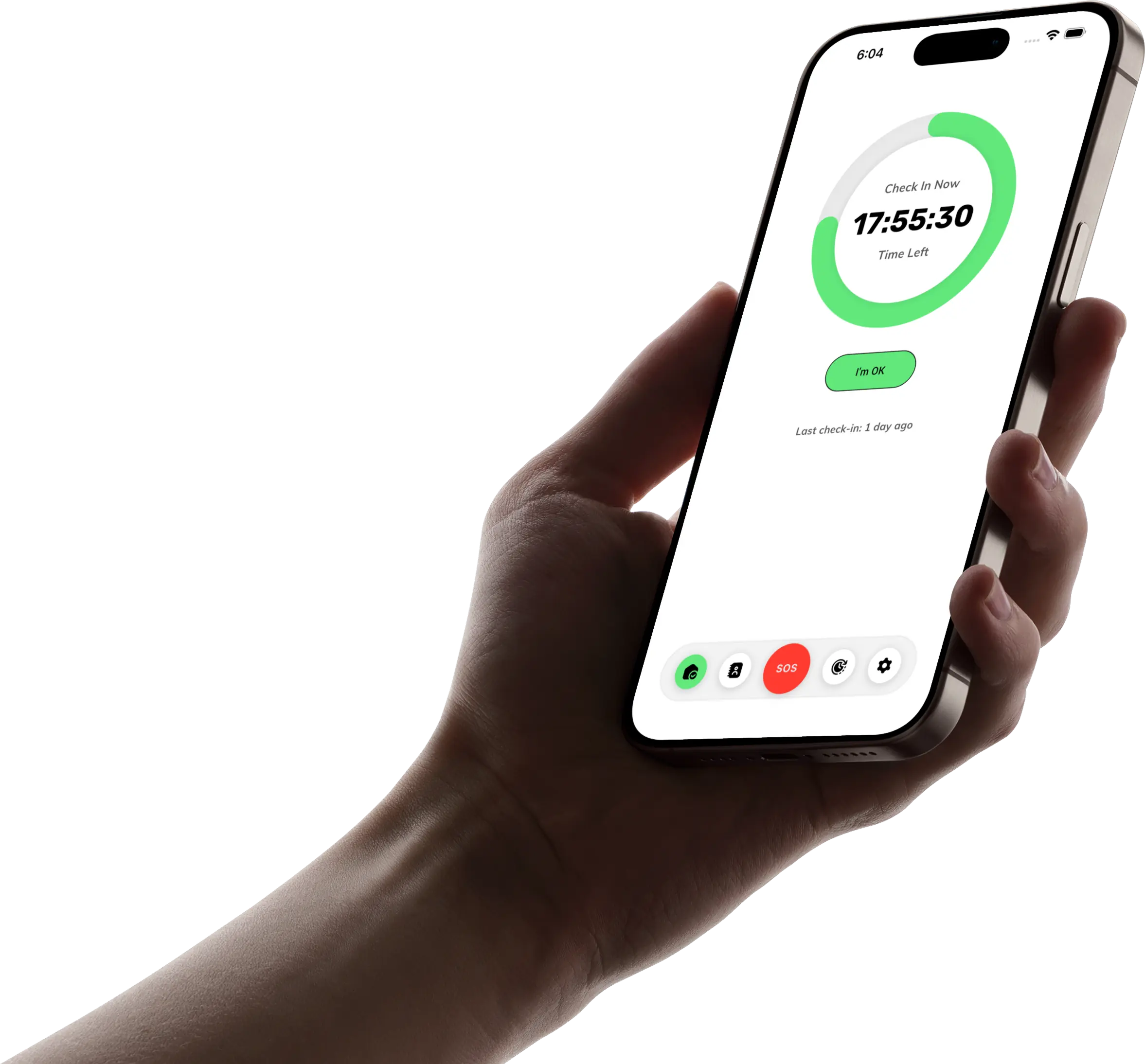
TapOkie works around a simple daily check-in. Once a day, you confirm you are OK with a single tap. If you miss the window — if you do not check in and your time passes — TapOkie sends an alert to your trusted contacts. That alert can include your last known location if you have enabled it.
Your contacts receive the alert via SMS. They do not need the TapOkie app installed. They do not monitor a dashboard during your day. They do not see anything unless something goes wrong.
For a specific meetup, you can set your check-in window to close an hour or so after you expect to be done. If the evening goes well and you are home safely, you check in as usual and your contacts hear nothing. If something is wrong and you cannot check in, they get the alert with your location.
The arrangement puts the information where it belongs: with someone who cares about you, available if needed, invisible otherwise.
Adding context with Safety Trail
If a particular situation feels like it warrants a little more, TapOkie's optional Safety Trail gives you a way to quietly log some context — without sharing a live feed.
When Safety Trail is switched on in Settings, a button appears in the app: "I'm with someone." Tapping it logs your current location at that moment. You might tap it as you leave home, when you arrive at the venue, or at any point during the evening. If you have a Premium account, you can also attach a photo — the venue, the person you are with, a nearby landmark.
None of this is visible to your contacts while you are out. They cannot open it and see where you are. The trail is only shared if you miss your check-in — in which case TapOkie includes a private link in the alert it sends. Your contact opens the link and sees the places you logged, in order, with any photos.
For a first date or a marketplace collection, this means your contact has genuinely useful information if they ever need it. Who you were with, where you went, what the place looked like. All from a few taps. Shared only if there is a reason to share it.
The Safety Trail guide explains the full detail of how it works, including privacy, how long data is kept, and the difference between free and Premium.
A simple approach for the day
Before heading out to meet someone new:
- Set your TapOkie check-in window to close an hour or so after you expect to be home or done
- If it feels right, switch on Safety Trail and tap "I'm with someone" when you leave and when you arrive
- Let a trusted person know roughly what you are doing — the check-in is the backup if you are not able to reach them or things go differently than planned
That is the whole approach. Your day proceeds as normal. If you check in as usual, your contact hears nothing. If you cannot, they get the information they need.
For people who meet new people frequently or travel solo, TapOkie's guidance for solo travellers covers how the check-in system fits into longer trips and unfamiliar places.
Privacy is part of the design
TapOkie is not a location-sharing app. Your contacts are not watching you. Your movements are not stored long-term or shared with third parties. Safety Trail data is permanently deleted after 90 days, and you can delete any entry yourself at any time.
Safety is about having a plan. This is a plan that respects your autonomy at the same time.
Download TapOkie to set up your first check-in.
See also: Check-in vs tracking — what's the difference? · What is Safety Trail? · Solo traveller safety
Common questions
Do I need to share my live location with my contact?
No. TapOkie does not share your location in real time. Your contact only receives a notification if you miss a check-in. That alert — not a live feed — can include your last known location or a link to your Safety Trail if you have been using it.
What does my contact receive if I miss a check-in?
They receive an SMS alert. If you have location sharing enabled, it includes your last known location. If you have been using Safety Trail, the alert includes a private link to the places and photos you logged. No app is required on their phone.
Can I use TapOkie for a single occasion rather than every day?
Yes. You control your check-in window and can set it for a specific day and time. Your contact only hears from TapOkie if you miss it. Nothing is mandatory or ongoing unless you want it to be.
Is Safety Trail available on the free version?
Location logging in Safety Trail is free. Photo attachments are a Premium feature. Premium also includes SOS, up to three contacts, and customisable check-in schedules.