By Syed Muhammad Daud Rizvi — Co-founder of TapOkie. Built the app after recognising how many people live alone with no simple way to let someone know they are OK each day.
When your children leave home and you're living alone for the first time in years, a daily safety check-in gives both you and your kids quiet reassurance. One tap a day confirms you're fine; if a check-in is ever missed, your chosen contacts are notified — no fuss, no constant surveillance.
The house is cleaner than it's been in years. The fridge stays stocked the way you left it. The television remote is exactly where you put it.
And it is very, very quiet.
For many parents, the year a last child leaves for university — or moves into their own place — marks a profound shift. You've been living with people for twenty-odd years. Now, often for the first time since your twenties, you're living alone. It can feel like freedom and loss all at once, sometimes on the same Tuesday afternoon.
Most of the practical conversation around this transition focuses on the emotional adjustment: the grief, the rediscovery of self, the surprisingly good parts. But there's a quieter, more practical question that doesn't get discussed as much: what happens if something goes wrong and nobody knows?
This isn't about catastrophising. It's about the ordinary, slightly odd reality of solo living — that for the first time in a long time, there isn't automatically someone else in the building.
The Shift Nobody Quite Prepares You For
When you were raising children, you were always, in some sense, accounted for. Someone knew roughly where you were. Someone would notice if you didn't come down for breakfast. The house had a natural check-in system built into its daily rhythm.
That rhythm is gone now. And while most days that's completely fine — you're capable, healthy, and living your life — the absence of it can sit at the back of your mind. Particularly on evenings you're home alone, or mornings when you've had a rough night, or the occasional moment when you slip in the kitchen and realise, just for a second, that nobody would know immediately.
Your adult children feel it too. They won't always say so directly — they don't want to seem like they're fussing — but many grown-up kids quietly carry a background worry about a parent living alone. It's not that they think you can't manage. It's just that they love you, and they know the math has changed.
What a Daily Check-In Actually Does
A safety check-in isn't surveillance. It isn't a tracker. It isn't an alarm you wear around your neck that announces to the world you need looking after.
It's a small, deliberate signal: I'm here, I'm fine, carry on.
The simplest version is an informal one: a text to a child or friend each morning, a quick call on the way to work. Many people do this already. The problem is that informal arrangements are easy to forget — on both sides — and when a message doesn't arrive, the person waiting for it doesn't always know whether to worry or just assume you're busy.
A more reliable approach is a dedicated check-in system with a clear protocol: if the check-in doesn't come through by a set time, your contacts are notified. No ambiguity. No "should I ring or is that embarrassing?"
How TapOkie Fits Into This
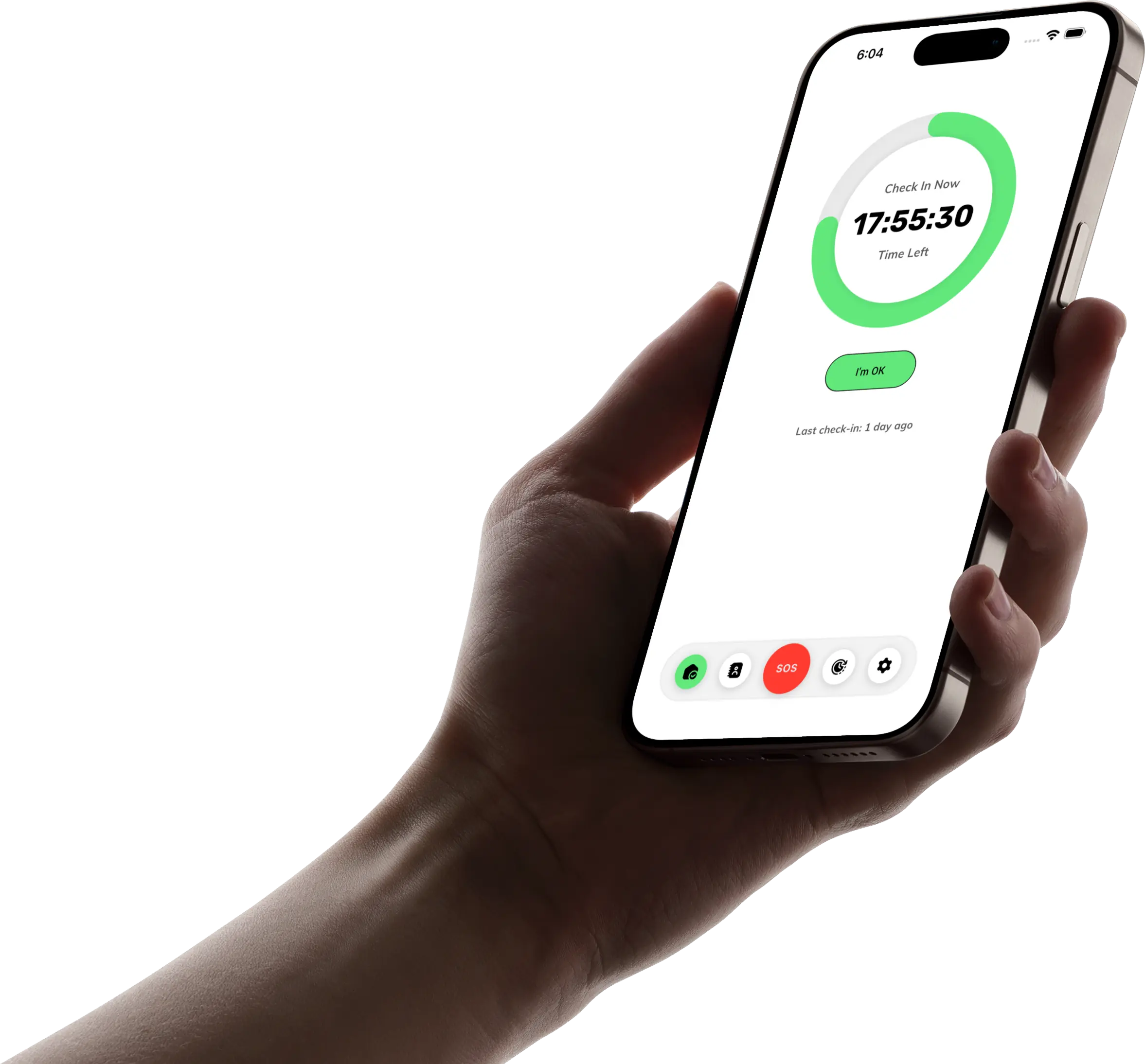
TapOkie is a daily check-in app built around a single action: one tap to say you're OK. Each day, when you're ready — morning coffee, before the commute, whenever fits — you open the app and tap. That's it.
If you miss a check-in, the people you've chosen as your contacts receive an SMS. They don't need the app themselves. They don't need to be watching a dashboard. They just get a message that says, in effect: your person hasn't checked in today — you might want to reach out.
A few things TapOkie is not, because it's worth being clear:
- Not continuous GPS tracking. Nobody is watching your movements or daily routine. Location is optional and only shared in the ways you choose — not an always-on map.
- Not a medical alert device. There's no hardware, no pendant, no call centre. It's a voluntary daily check-in, not an emergency response system.
- Not something that treats you as vulnerable. The app is used by people in their thirties, forties, fifties and beyond who simply want a quiet safety net — not because they can't look after themselves, but because it's sensible to have one.
There's a free tier that covers the essentials, and a Premium option for additional features. The whole point is that it fits into your day without demanding much of it.
The Conversation With Your Kids
One of the genuinely useful side-effects of setting up a daily check-in is that it gives you something concrete to say to your children when they ask, perhaps a little awkwardly, whether you're OK living alone.
"I've set up a check-in app — if anything's ever off, you'll hear from it" is a very different conversation from "I'm fine, don't worry." The first one is reassuring in a practical way. It lets them stop carrying a background worry they'd never quite admit to.
It also keeps the power where it belongs: with you. You're not asking them to check up on you. You're telling them that you've made a sensible arrangement, and they can get on with their lives.
Common Questions
Isn't this a bit over the top if I'm healthy and in my fifties?
Not really. The whole point of a safety net is that you set it up before you need it, not after. Most people who use daily check-in apps are healthy, active, and managing perfectly well — that's exactly who they're designed for. It's not about expecting something to go wrong. It's about covering for the small chance that something might, without letting that possibility take up much mental space.
What if I just forget to check in one day?
That's genuinely fine — it happens. If you miss a tap, your contacts get a message. They'll probably send you a text. You reply, everyone relaxes, and you carry on. The system is designed to be low-stakes: a gentle flag, not an emergency procedure. Over time, the check-in becomes part of your morning routine and forgetting it becomes rare.
Do my children need to download anything?
No. Your contacts receive an SMS if a check-in is missed — nothing more. They don't need an account, don't need to install anything, and don't need to monitor a dashboard. This is intentional: the fewer barriers there are for them, the more reliably the safety net works.
Can I choose more than one contact?
Yes. The free plan covers one verified contact; Premium lets you add more — for example a child, a sibling, and a close friend or neighbour. Spreading it across a few people means that even if one person is travelling or unavailable, someone will see the message. It also means no single person carries all the responsibility.
The empty nest is many things at once: a loss, a beginning, a chance to rediscover what your life looks like when it's shaped by you. Most of it is fine. Most days are good.
But "mostly fine" and "completely without risk" are not quite the same thing, and pretending otherwise doesn't serve you or the people who care about you. A daily check-in is one of the smallest, least intrusive ways to bridge that gap — a single tap that says I'm here and lets everyone, including you, relax.
If it sounds like something that might fit, you can download TapOkie and try it.
Related reading: How to Talk to an Aging Parent About a Safety App · How to Set Up a Safety Check-In Routine for an Ageing Parent · Check-In vs Tracking: I Just Want Someone to Know I'm OK