By Syed Muhammad Daud Rizvi — Co-founder of TapOkie. Built the app after recognising how many people live alone with no simple way to let someone know they are OK each day.
When you live abroad, the best way to check on an elderly parent is to agree on a simple daily ritual — a morning tap, a WhatsApp voice note, or a scheduled check-in app like TapOkie — backed by a local contact who gets an automatic alert if something is missed.
There is a particular kind of worry that belongs to the adult child living in another country. It is not constant — life carries on — but it surfaces every time a message goes unread for a few hours, or when Mum's phone goes straight to voicemail, or when you calculate the time difference and realise it is already late evening there and you have not heard from her today.
The worry is not about anything specific. It is about the gap between "probably fine" and "definitely fine" — and the fact that, unlike siblings who live nearby, you cannot simply drive over and check.
That gap is the thing worth thinking about seriously. Not in a frightening way, but practically. Because most of the difficulty of caring for an elderly parent from another country is not medical or financial — it is the absence of a reliable daily signal that says: still here, still OK.
Why Daily Phone Calls Don't Scale Across Time Zones
For many families, the instinct is to phone every day. And daily contact is genuinely valuable — it maintains the relationship, catches small worries early, and gives both sides a sense of connection.
But daily calls have a structural problem when you live in a different time zone: you are at the mercy of clashing routines. If your parent is in the UK and you are in Canada, there is a window of a few hours that is reasonable for both sides. Miss that window — a late meeting, school pickup, a busy day — and suddenly it has been 36 hours since you last spoke and you are doing mental arithmetic at 11pm your time, wondering whether to call.
What families in this situation often need is not more calls, but a separate, low-effort signal that is not dependent on a conversation happening. Something that says "OK" automatically, and only asks for attention when it does not.
Who Should Be the Verified Contact — and Why It Matters
One of the first practical questions when setting up any check-in system for a parent abroad is: who gets the alert if something goes wrong?
The obvious answer is you — the adult child overseas. But there is a real problem with that. If your parent misses their morning check-in at 8am GMT, that might be 2am where you are. You may not see the message until you wake. You may see it and have no way to act on it immediately because you are not physically present.
A better structure is usually layered:
A local contact gets the first alert. This might be a neighbour with a spare key, a sibling or cousin who lives nearby, a close friend, or a regular carer. They are the person who can actually knock on the door within the hour.
You are also notified. You stay fully in the loop, but you are not the sole point of action.
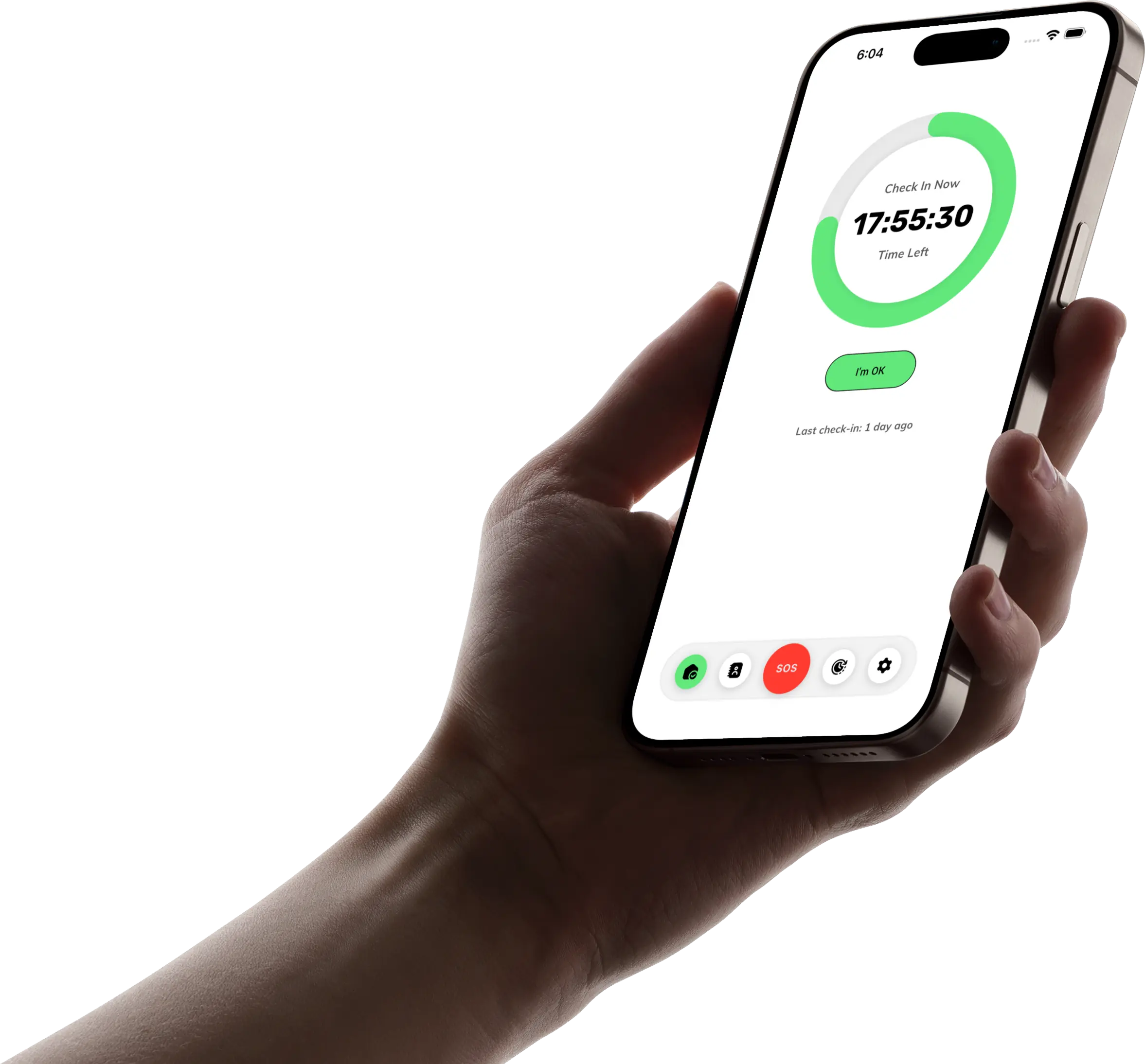
This is exactly the model that apps like TapOkie are designed around. Your parent does one tap each morning (or at whatever time suits them) to confirm they are OK. If the tap is missed and the grace period passes, TapOkie sends an SMS to their verified contacts — no app required on the contact's end. You can be one of those contacts from anywhere in the world, and so can a neighbour three streets away.
It is worth noting that TapOkie's Premium plan allows up to three contacts and lets you set different SMS languages per contact — which is genuinely useful when your family spans multiple countries and not everyone reads English as a first language.
The Sibling Coordination Problem
If you have brothers or sisters, some of whom live near your parent and some of whom do not, you will probably recognise this pattern: the sibling who is physically closest ends up carrying most of the day-to-day responsibility, while those abroad feel a mixture of guilt and helplessness.
A shared check-in system does not solve that imbalance entirely, but it does something useful: it makes information visible to everyone at once. When a check-in is missed, the alert goes to all contacts simultaneously. No one sibling is the sole information-holder. Conversations about whether to call, whether to visit, whether to worry — they can happen between people who have the same facts in front of them.
This also reduces the quiet resentment that can build when the local sibling feels like the only one paying attention. The system pays attention on everyone's behalf.
Privacy, Dignity, and the Difference Between Check-In and Surveillance
Adults living alone — whatever their age — are entitled to privacy. Many parents are uncomfortable with the idea of children monitoring them, and rightly so. The conversation about introducing a check-in system has to be handled with that in mind.
The meaningful distinction is between passive surveillance (continuous location tracking, camera-based monitoring, wearables that stream data constantly) and active check-in (your parent chooses to tap a button each day to say they are OK).
TapOkie is firmly in the second category. There is no continuous GPS tracking, no monitoring hardware, no constant data stream. Your parent does something deliberate and positive each morning — a small act of self-reporting that is on their terms. Nothing happens unless they choose not to tap. The system is designed around the parent's agency, not around watching them.
That framing tends to land very differently in the conversation. It is not "we want to keep an eye on you." It is "we want a system where we don't have to worry unless there's actually something to worry about."
For a guide on how to have that conversation, see How to Talk to an Ageing Parent About a Safety App.
What Happens When the SMS Arrives in Another Country
If you are a verified contact based abroad, you will receive an SMS from TapOkie if your parent's check-in is missed. International SMS delivery is part of how TapOkie operates — available across 25+ countries — so the message should arrive just as it would for a local contact.
When it does arrive, your role is usually not to panic but to trigger the local response. That might mean messaging the neighbour who has the key, calling your local sibling, or ringing your parent's mobile directly. The SMS is not a declaration of emergency — it is an early flag that something is worth checking on.
Most of the time, a missed check-in has a mundane explanation: they forgot, they slept in, their phone battery died, they are visiting someone. The value of the system is that you find out quickly and can rule those things out, rather than discovering hours later that no one had noticed.
Building the Routine: Practical Tips
Getting a daily check-in habit established takes a little intentional setup. A few things that help:
Tie the check-in to something already habitual. Morning tea, the first coffee, switching on the radio. A tap that slots into an existing routine is much easier to maintain than one that exists in isolation.
Set the check-in time in your parent's time zone, not yours. Their morning is the natural moment. What that translates to for you is secondary — the system handles the alert regardless of what time it is where you are.
Use Premium's custom schedules if your parent's routine varies. If they regularly visit family on Wednesdays or have a standing lunch club on Thursdays, the check-in time can reflect that. Premium also includes a pause or skip option for planned absences like holidays — avoiding false alarms when they are travelling.
Start with a trial period. Some parents find the habit easy; others need a few weeks to get used to it. It helps to frame the first month as "let's see if this works for us" rather than committing to it permanently from day one.
Common Questions
Do my contacts need to download an app? No. Verified contacts receive a standard SMS if a check-in is missed. They do not need a smartphone, an account, or any app installed. This is particularly useful for older neighbours or family members who are not especially tech-comfortable.
What if my parent travels internationally? TapOkie works in 25+ countries, so if your parent is visiting you or another family member abroad, the check-in can continue as normal. Premium's pause or skip feature means they can also pause check-ins for the duration of a trip if preferred.
Is there a free version? Yes. TapOkie has a free tier that covers core daily check-in functionality. Premium (around $4.99/month or $44.99/year) adds multiple contacts, custom schedules, grace period settings, per-contact SMS languages, and an emergency button.
What if I'm the only contact and I'm in a different time zone? It is worth adding at least one local contact — a neighbour, friend, or family member who can physically respond — even if you are also a contact. Being notified from abroad is useful; being able to act locally is what matters most in the rare case where something has genuinely happened.
Is TapOkie a medical alert device? No. TapOkie is a daily check-in app. It is not a medical alert button, a fall-detection device, or a call-centre service. It is a lightweight daily "I'm OK" signal that triggers an SMS to family if missed. For parents with significant health needs, it works best alongside — not instead of — appropriate medical support.
Related reading: How to Check on Elderly Parents Remotely · Setting Up a Safety Check-In Routine for an Ageing Parent · Check-In vs Tracking · Living Alone After Bereavement · Alexa Care Hub vs Daily Check-In App
If you are living abroad and looking for a simple, non-intrusive way to stay connected to a parent at home, download TapOkie and take a look at the guide for families. Setup takes a few minutes, and your parent does not need to be especially tech-savvy to use it.