Af Syed Muhammad Daud Rizvi — Medstifter af TapOkie. Byggede appen, fordi så mange bor alene uden en enkel måde at sige, at de har det godt hver dag.
Millions live alone across the UK, US, and Canada. The shared safety gap is not loneliness alone — it is delay before discovery when something goes wrong. Intentional daily check-ins with SMS escalation close that lag without importing continuous tracking norms from family locator apps.
In the UK, approximately 8.4 million adults live in single-person households — around 30% of all households, making solo living the most common household type in the country. In the US, it is around 38.5 million. In Canada, 4.4 million. Across most high-income countries, the share of people living alone has been rising for decades.
That is the scale of the problem. Yet the products marketed as "safety" for people who live alone still assume one of two bad options: constant monitoring, or nothing at all until a crisis.
Solo living is not a niche lifestyle — it is the defining household trend of the last fifty years. That mismatch is the problem TapOkie exists to address.
The scale of solo living: UK, US, and Canada
United Kingdom. Approximately 8.4 million adults in the UK live in single-person households - a scale that makes "someone will notice if something goes wrong" an unreliable assumption for millions of people. Official household statistics are updated over time; for the latest figures, see the Office for National Statistics families and households releases.
United States. The U.S. Census Bureau's America's Families and Living Arrangements estimates show the growth of one-person households in stark terms: in 2024, there were about 38.5 million one-person households - roughly 29% of all U.S. households. That is not a small segment; it is nearly a third of the country's housing landscape. Source: U.S. Census Bureau news release, November 2024.
Canada. Statistics Canada's Census of Population (2021) reported that about 4.4 million people aged 15 and older in private households lived alone - about 15% of that population - and that one-person households represented about 29% of all private households, the most common household type in the country. See Statistics Canada - Living solo and the related census table release.
The pattern is consistent: millions of capable, independent adults are structurally alone in their daily lives - geographically distant from adult children, working remotely, travelling, or ageing in place - and silence is harder to interpret than absence.
The hidden risk isn't drama - it's delay
Medical emergencies get headlines. Falls get attention. What's harder to narrate publicly is delay: the gap between something going wrong and anyone realising something is wrong.
For many households, reassurance still depends on improvised systems - WhatsApp streaks that break on busy weeks, unanswered calls that feel like nagging, or nothing at all. That is tolerable until it isn't.
Why "more tracking" is the wrong default
When families panic, vendors sell GPS. Tracking can be appropriate - but as a default caregiving stance, GPS often backfires emotionally: the older adult feels watched. The younger adult feels responsible for surveillance instead of conversation. Nobody feels freer.
We explore that dynamic in depth in our companion piece: Why Tracking Apps Fail Older Adults - and What to Use Instead.
A different shape of tool: intentional signal instead of ambient monitoring
Better solo-living tools share a few traits:
- Consent-led. The person using the product should be the author of the signal - not passively mined for data.
- Low friction. A safety habit that relies on heroic discipline every day collapses faster than anyone admits.
- Human escalation. The goal is loop in trusted people - family, neighbours, chosen contacts - rather than outsource care to dashboards.
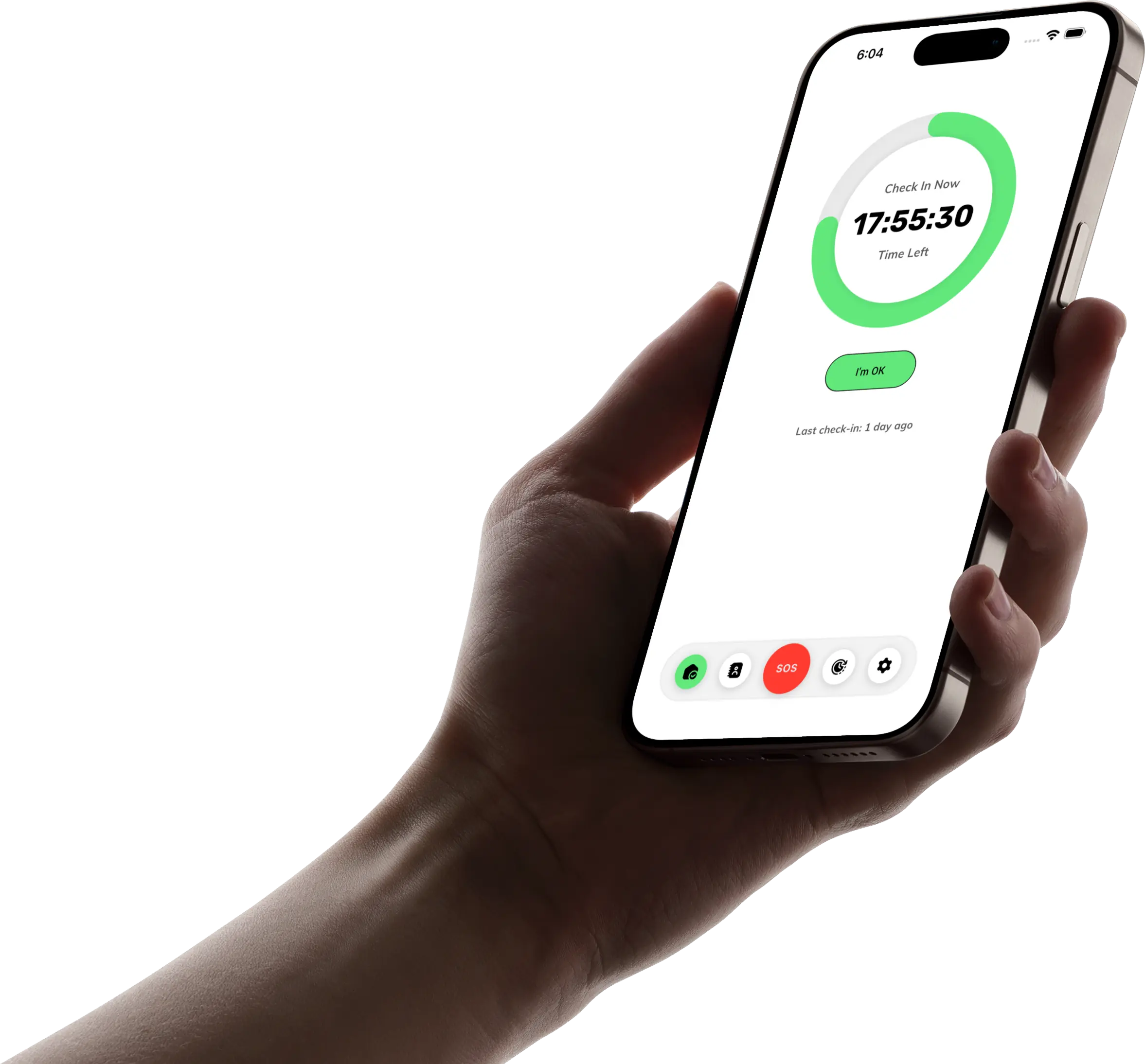
That is exactly what TapOkie is designed around: once a day, you intentionally confirm that you're okay. If that signal is missed, trusted contacts receive an SMS - contacts don't need TapOkie on their phone. Location sharing (if you enable it) stays under your device's permission controls - Always, Only While Using App, or off. Details: FAQs.
It is deliberately boring technology. Safety products should probably be boring when they ship.
What this means if you're not in the UK
If you landed here from messaging or social posts centred on Britain: the UK's numbers are illustrative, not exhaustive. Comparable dynamics show up wherever solo households dominate - Vancouver, Calgary, Glasgow, Leeds, Minneapolis, Austin, Lisbon, Osaka. Geography changes tax laws and GSM carriers; it rarely changes loneliness or delay.
We're here to argue for one narrow thing: independence still needs lightweight safety nets - and nets are allowed to be humane.
If falls or delay after a setback sits in the back of your mind, Living Alone and Worried About Falls? 5 Tools That Actually Help is a concrete companion-not medical advice, but practical ordering. Helping a parent remotely? How to Set Up a Safety Check-In Routine for an Ageing Parent keeps the rhythm humane.
If you live alone - or worry about someone who does - you can download TapOkie and set up a daily check-in in minutes. Prefer a comparative lens first? Start with TapOkie vs other check-in apps.
Common questions
Is the UK uniquely high in solo living?
Several Western countries show high one-person household rates; use official stats for the latest comparators.
What is the practical takeaway?
Build a habit that produces a signal if you go quiet, regardless of country.
Do healthcare systems solve delay?
Not for private daily life. Community care and hospital discharge still leave large alone-home windows.
How does TapOkie help internationally?
Same daily check-in model serves users who keep a phone number contacts can reach.