Por Syed Muhammad Daud Rizvi — Cofundador da TapOkie. Criou a app ao ver quantas pessoas vivem sozinhas sem uma forma simples de dizer todos os dias que estão bem.
Safety apps for women living alone usually fall into daily check-ins, panic or SOS buttons, and location sharing. For everyday peace of mind, a lightweight check-in with SMS when you miss a window often works better than continuous GPS or tools that force every contact to install software.
Living alone has real advantages: independence, quiet, your own schedule. But it also means there is no one in the house to notice if something goes wrong. For women living alone, that awareness shapes how you think about safety at home and when you're out.
According to the Office for National Statistics, women make up the majority of single-person households in the UK for those aged 45 and over. In the US, the Census Bureau reports that women account for around 57% of all single-person households. The safety considerations that follow from living alone are not abstract — they are structural and very common.
This guide covers what actually works — apps that give your circle a signal if you don't check in, personal safety tools for when you're out, and what to skip.
The Three Categories Worth Your Time
Safety apps for solo living broadly fall into three types:
- Daily check-in apps — you confirm you're OK once a day; if you don't, someone trusted gets an SMS
- Personal alarm apps — a loud sound or call to emergency services when triggered
- Location sharing apps — continuous or on-demand GPS so someone can see where you are
Each solves a different problem. Most people need a combination, not just one.
Daily Check-In Apps
A daily check-in is your baseline safety net. It is not for emergencies in the moment — it is for the situation where something happens and no one realises for hours.
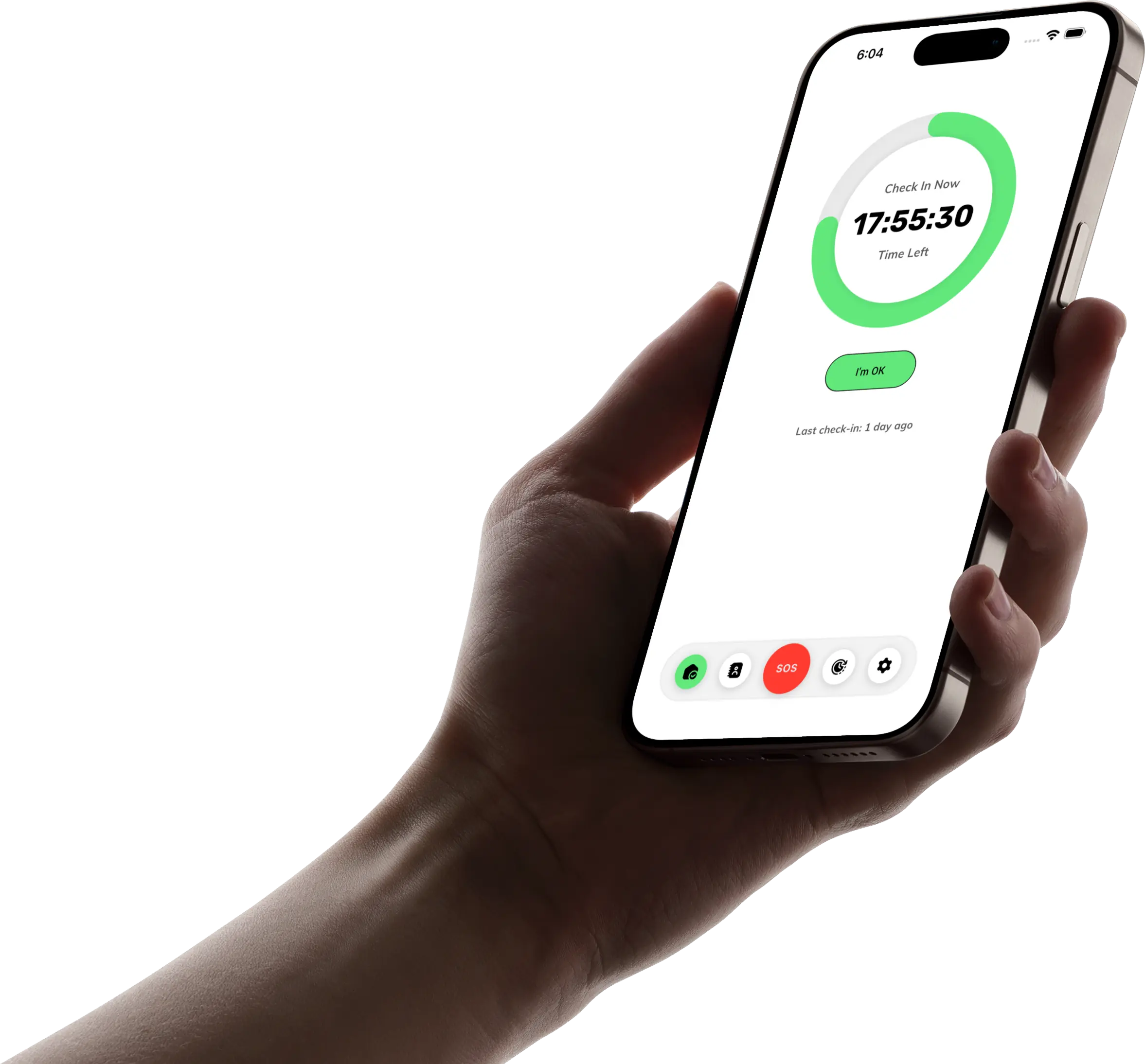
TapOkie is built specifically for this. You tap once a day to say you're OK. If you miss your window, your chosen contacts get an SMS — no app needed on their end. They do not need a smartphone or to install anything.
What makes it relevant for women living alone:
- Contacts are verified — each person you add confirms by SMS before they're in your circle. No one is added without agreeing.
- No always-on location — TapOkie does not track you continuously. You choose whether your last known location is shared in alerts, through your device's permission settings. You can set it to "Don't Allow" and the check-in still works.
- Emergency button on Premium — one tap alerts your contacts immediately, outside the normal window. If something is wrong right now, you do not wait until end of day.
- Free to start — one contact, daily check-in, SMS on miss. No credit card required.
Download TapOkie free to set up your first check-in.
For a broader comparison of check-in apps, see Best Daily Check-In Apps for People Living Alone (2026).
Personal Alarm Apps
Personal alarm apps are for the moment something is wrong, not the quiet background risk of living alone. They typically do one or more of:
- Play a loud siren to deter an attacker
- Call emergency services automatically
- Send an SOS with your GPS location to contacts
These complement a check-in app rather than replace it. A panic button is useful when you can press it. A check-in app protects you when you can't.
Things to verify before you install:
- Does it work offline? GPS and data can fail at the worst moments.
- Does it require a subscription to call emergency services?
- Does it clearly show contacts who is listed and how to respond?
Location Sharing Apps
GPS sharing apps like Life360 let people see where you are in real time. For some situations — regular late-night commutes, hiking alone — this has clear value.
But continuous tracking is not for everyone. If you value privacy at home, or have family members who could misuse location access, always-on GPS can feel less like safety and more like surveillance.
A middle path: use a check-in app like TapOkie for everyday baseline assurance, and share your live location with a trusted person only when it's relevant — a specific journey, a first date, a late shift.
See Privacy-First Safety Apps: The Complete List for an honest breakdown of which apps track what.
What to Avoid
- Apps that list you as "safe" based on phone activity rather than your explicit confirmation — a phone sitting on a desk looks the same as a safe person
- Subscriptions that expire free trials and leave you unprotected without warning
- Apps that add contacts without requiring their consent — if they didn't agree to be in your safety circle, they may not respond
Practical Setup for Women Living Alone
1. Choose one person as your first contact — someone reliable who checks their phone daily. A parent, sibling, close friend, or neighbour. 2. Set up a daily check-in app — TapOkie takes under two minutes to configure. Your contact receives a one-time verification SMS and agrees to be in your circle. 3. Decide on your location sharing preference — "Don't Allow", "Allow While Using App", or "Always". You can change this at any time in your device settings. 4. Add a personal alarm app for when you're out at night or in an unfamiliar place. 5. Tell someone you've set this up — if your contact knows what to expect, they're more likely to respond quickly when an alert arrives.
The Bottom Line
The best safety setup for women living alone is not the most expensive or the most complex — it is the one you actually use every day. A simple daily check-in creates a reliable baseline. Everything else builds on top of that.
Get started with TapOkie free — one tap a day, and the people who matter know you're OK.
See also: Living Alone Safety Checklist: 10 Things to Set Up for a broader home and digital safety walkthrough.
Common questions
What is the best first safety step living alone?
Set a daily check-in habit with at least one verified contact who can be reached by ordinary SMS if you go quiet.
Do I need a panic button app?
Panic tools help some people for acute situations; they do not replace a delay-to-discovery safety net if you become unresponsive.
Should contacts download the same app?
Not ideally. SMS-first designs avoid gatekeeping help on whether a parent or friend will install something.
Can TapOkie help?
Yes. Free-tier daily check-ins and SMS on miss cover many living-alone risks without always-on tracking.