Door Syed Muhammad Daud Rizvi — Medeoprichter van TapOkie. Bouwde de app omdat zoveel mensen alleen wonen zonder eenvoudige manier om dagelijks te laten weten dat het goed gaat.
A daily check-in is a voluntary, timed signal you send once a day to confirm you are fine. Your contacts see nothing unless you miss it — no location, no activity, no history. GPS tracking is continuous and always-on. They solve different problems, and if your concern is the delay between something going wrong and someone noticing, a check-in addresses that without any tracking at all.
"I don't want to be tracked. I just want someone to know I'm OK."
This is one of the most common things people say when they start thinking about personal safety apps. And it is a completely reasonable position. The idea of someone monitoring your location, watching your movements, seeing where you are at every moment — that does not feel like safety. It feels like surveillance.
Here is the thing: a daily check-in is not tracking. The two are not the same, and confusing them leads people to reject useful tools they would actually be comfortable with.
What Tracking Actually Is
GPS tracking apps — Life360, Find My, Google's location sharing — work by continuously reporting your location to other people. When your family member opens the app, they see where you are right now. They can see where you have been. The data is collected constantly, regardless of whether anything is wrong.
This is useful for some things (keeping track of children, coordinating with family across a city). But it is an ongoing stream of information about your movements, and for many people — especially adults who value their autonomy — that crosses a line.
Tracking answers the question: where are you? at any moment, all the time.
What a Daily Check-In Actually Is
A daily check-in works completely differently.
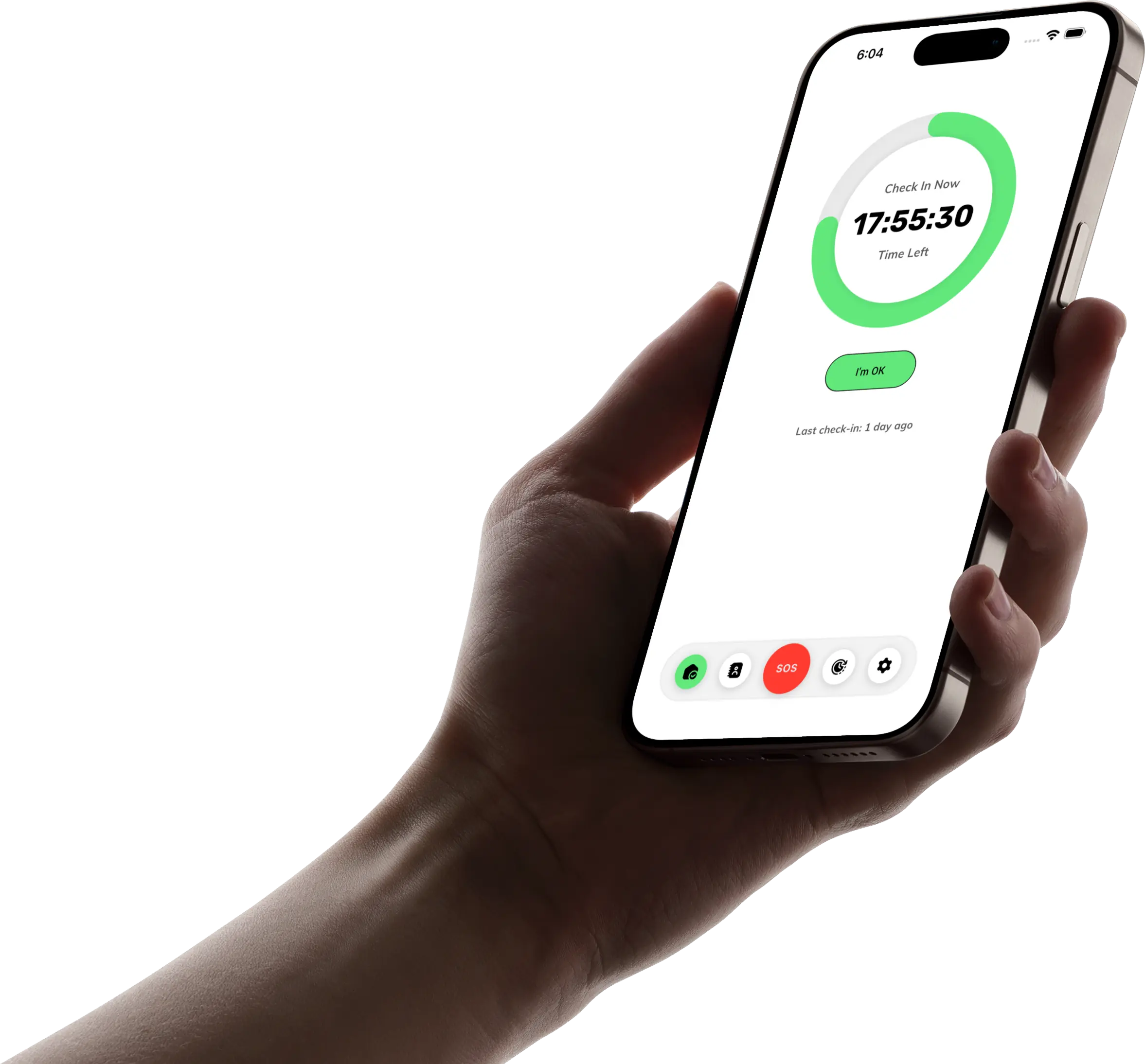
Once a day, you tap a button on your phone. That tap tells the app: "I am OK at this moment." Your contacts — the people you have chosen to include — receive no notification. They hear nothing. They do not know where you are. They do not see your location. The tap is just a confirmation that you are fine.
If you miss your tap — you forget, or you are unable to tap because something has gone wrong — your contacts receive a simple SMS message saying you have not checked in today and may want to reach out.
That is the entire system. Your contacts see nothing unless you miss. When you miss, they get a text prompt to check on you — not an alarm, not a location, just a flag.
Check-in answers the question: are you OK today? once a day, and only surfaces information if the answer might be no.
What Your Contact Sees
On a normal day when you tap: nothing. Your contact goes about their day with no alerts, no notifications, no information about your movements.
On a day when you miss your check-in: an SMS from TapOkie with your name, noting that you have not checked in today, and suggesting they may want to reach out if this seems unusual.
There is no location attached. There is no history of your movements. There is no tracking data. The message is a prompt to make a phone call — the kind of thing your contact might do anyway if they realised they had not heard from you in a while.
Why the Distinction Matters
The fear of being tracked is not irrational. Continuous location monitoring changes relationships. It creates dynamics where one person can always check up on another. It generates data about your routine that you may not want to share. It can feel infantilising for adults who value their independence.
None of those concerns apply to a daily check-in. You control when you tap. You control who your contacts are. On most days, your contacts know nothing. The only information that goes anywhere is: "today was fine."
The exception is a missed day. And that is precisely the exception that matters — because if something has gone wrong, the window between the emergency and someone knowing is what determines outcomes.
The One Problem a Check-In Solves
Most safety tools try to do many things. A check-in does one specific thing: it closes the delay gap between something going wrong and someone finding out.
When you live alone or work alone, that gap can be hours or days. People do not check in on you unless prompted. A missed call might get a follow-up, or might be assumed to be a busy day. Nobody has a reason to escalate.
A check-in creates that reason automatically. Miss a day, and someone you trust has a specific, timed prompt to contact you. The gap shrinks from days to hours — or less.
That is all it does. It does not detect falls. It does not share your location. It does not monitor your activity. It just ensures that someone knows if a day passes without hearing from you.
How [TapOkie](/download) Works
TapOkie is built specifically on the check-in model.
You download the app. You add one or more contacts — family, a friend, a neighbour. Each contact receives a verification SMS and confirms they are happy to be included.
Each day, you tap "I'm OK." Your contacts hear nothing. If you miss your window, they receive an SMS.
Your contacts do not need to install anything. They receive a plain text message on any phone. They do not have a TapOkie account. They do not see any information about your daily movements.
See how it works in three steps for the full picture, or download TapOkie free and set it up in under two minutes.
See also: Privacy-First Safety Apps: The Complete List if you want to compare tools on the privacy dimension, and Best Safety Apps for Women Living Alone for a broader look at personal safety options.
Download TapOkie free — setup takes under two minutes, and your contact gets their verification SMS today.
Common questions
Can my contacts see my location?
No. TapOkie does not share your location with anyone. Contacts see only whether you have checked in. On a day you tap, they see nothing at all.
What if I forget to tap one day?
Your contacts get an SMS. They may ring or text to check on you. If you are fine and simply forgot, a quick reply reassures them. This is a minor inconvenience; the alternative is that a day where you are genuinely unable to tap passes unnoticed.
Can I choose when my check-in window closes?
Yes. You set the window to suit your routine. If you are a night owl, set it for late evening. If you travel, you can adjust the window or check in early.
Is my tap data stored somewhere?
TapOkie records whether you tapped on a given day in order to know whether to alert contacts. You can see your own check-in history in the app. It is not shared with third parties and is not used to monitor your movements.
What is the difference between this and a panic button?
A panic button requires you to press it in an emergency. If you are incapacitated, you cannot press it. A daily check-in works in reverse — the absence of your tap triggers the alert, which means it covers emergencies where you cannot act at all. The two approaches are complementary for different risks.