Par Syed Muhammad Daud Rizvi — Cofondateur de TapOkie. A créé l'appli en constatant combien de personnes vivent seules sans moyen simple de dire chaque jour qu'elles vont bien.
Solo travellers benefit from a lightweight check-in so someone at home knows you are OK each day, without continuous tracking that drains battery and trust. Choose apps that work over SMS or offline-friendly patterns and that let you pause when you want silence rather than vanish unannounced.
Solo travel — whether you call yourself a solo traveller or a solo traveler — is one of the more liberating things you can do. It is also the scenario where a missed check-in matters most, because nobody else knows your plans.
The UK Foreign, Commonwealth & Development Office (FCDO) publishes travel safety advice for every country and consistently identifies communication — letting people know your whereabouts and plans — as a primary solo travel safety behaviour. A daily check-in app automates that communication habit without GPS tracking.
This guide covers what a check-in app for solo travel actually does, how it differs from GPS tracking, and what to look for when you are choosing one.
What problem does a check-in app solve for solo travellers?
When you travel alone, there is nobody at the hostel who knows your itinerary, nobody at home who knows which train you took, and no system that notices if you go quiet. A missed WhatsApp is easy to explain away. A missed check-in with a 24-hour window is harder to ignore.
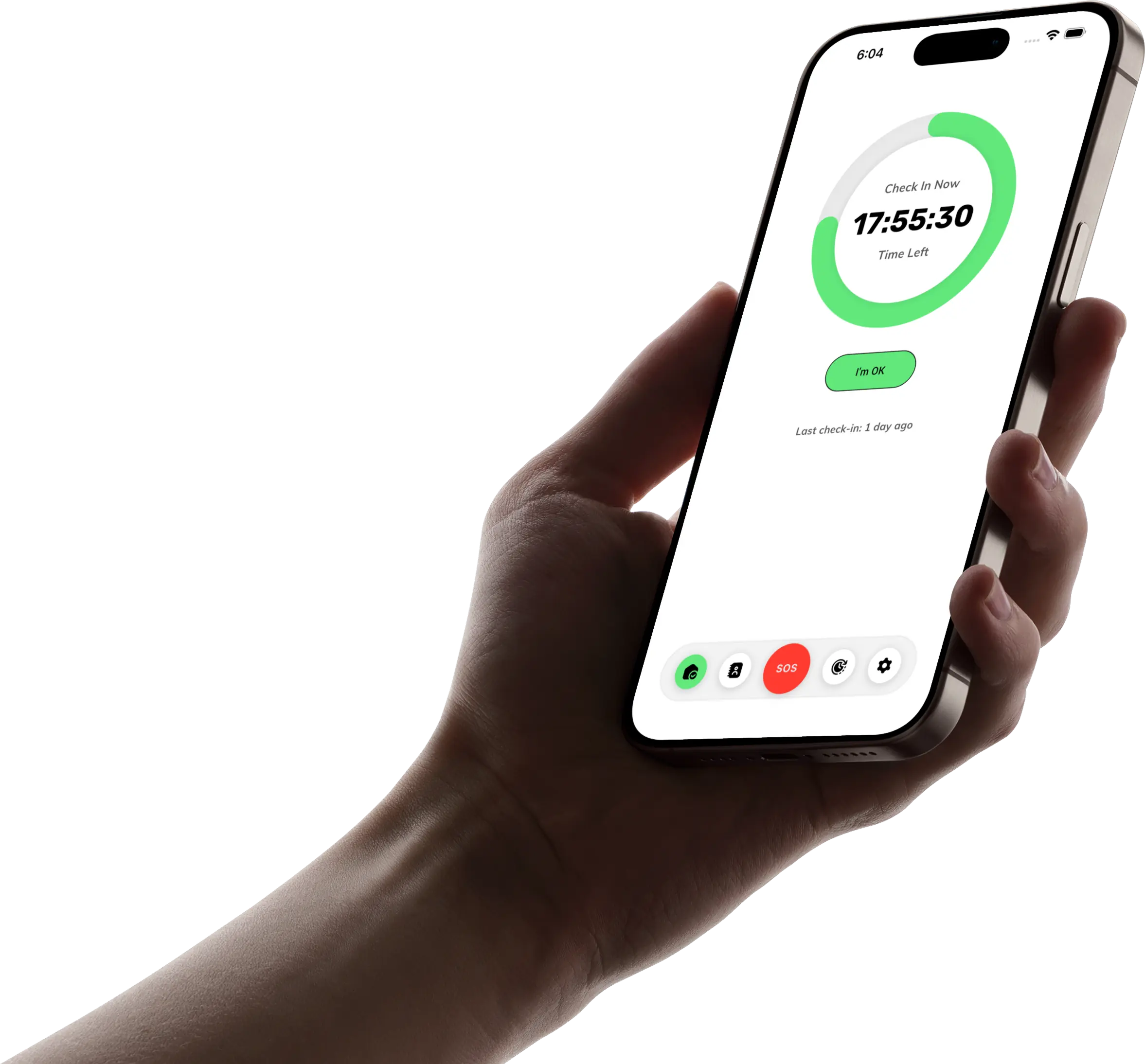
A check-in app creates a simple daily signal: you tap once to confirm you are OK. If you miss your window, the people you designated get an automatic alert. That alert is the safety net - not real-time surveillance, just a clear indication that something may be wrong and someone should check.
Check-in app vs GPS tracker: the key difference
GPS tracking apps (Life360, Find My Friends, and similar) solve the question: where are you right now? They show a live map of your location to your contacts, continuously, in the background.
A check-in app solves a different question: did you confirm you are OK today? Your contacts see nothing unless you miss your window. There is no live map, no location history, no way for someone to see that you spent three hours at a particular cafe.
For solo travellers who want a safety net without sharing their real-time movements with family, the check-in model is usually the better fit.
- GPS tracker: contact sees your location whether you want them to or not
- Check-in app: contact hears nothing until you miss, then gets an SMS
TapOkie falls into the check-in category. Location in alerts is optional - you choose whether to share it through normal iOS or Android permission settings.
What to look for in a solo travel check-in app
1. Works across borders Your app should work in the country you are travelling to. Check whether SMS alerts reach international numbers - not all apps support this. TapOkie operates in 25+ countries.
2. Contacts do not need to install anything If your mum needs to download an app before she can receive an alert, she probably will not. Look for SMS-based alerts that land on any phone.
3. You can pause or skip dates Travel is unpredictable. A day without internet access, a transit day with a different schedule, or a planned offline experience should not trigger a false alarm. Premium plans (including TapOkie Premium) let you pause check-ins or skip individual dates.
4. The grace period is generous A 15-minute grace period after your window closes means a delayed bus or a late dinner does not send your contacts into a panic.
5. Emergency button for genuine emergencies A daily check-in handles the routine case. For genuine emergencies - injury, feeling unsafe, a situation you cannot talk out of - a one-tap emergency button that alerts your circle immediately is a useful additional layer. Available on TapOkie Premium.
Setting up TapOkie before you travel
1. Download TapOkie free and set your daily check-in time to match your typical travel rhythm - evening works for most travellers. 2. Add your verified contacts (up to 3 on Premium). Each contact confirms by SMS before they join your safety net - they do not need the app. 3. Set location sharing preferences - Always On, While Using App, or Off. You choose. 4. Use pause and skip on days you know you will be offline. 5. Test before you go - do a check-in and confirm your contacts received it.
The practical reality
A check-in app will not call the embassy for you. It will not GPS-track you to a hospital. What it does is create a 24-hour rhythm that gives one or two people a clear signal if something has gone wrong - without you having to share your movements constantly.
For most solo travellers, that is exactly the right trade-off: independence by default, safety net on exception.
Related: Privacy-first safety apps for solo travellers, check-in app vs GPS tracker vs medical alert: which type do you need?, and best daily check-in apps for living alone (2026).
Heading somewhere soon? Download TapOkie free, add one contact before you leave, and your daily check-in is live. Setup takes under two minutes.
Common questions
Should I share GPS constantly while travelling?
Only if you want that closeness. Many travellers prefer daily OK taps with location only at miss or on SOS.
Do hosts or friends abroad need the app?
Not for SMS-first designs — home contacts can be the entire circle.
What about roaming and connectivity?
Test check-ins when you arrive. Missed windows should still alert if the habit breaks due to signal.
Is TapOkie suitable abroad?
If your phone has data or SMS capability and contacts can receive texts, the daily habit still applies.